
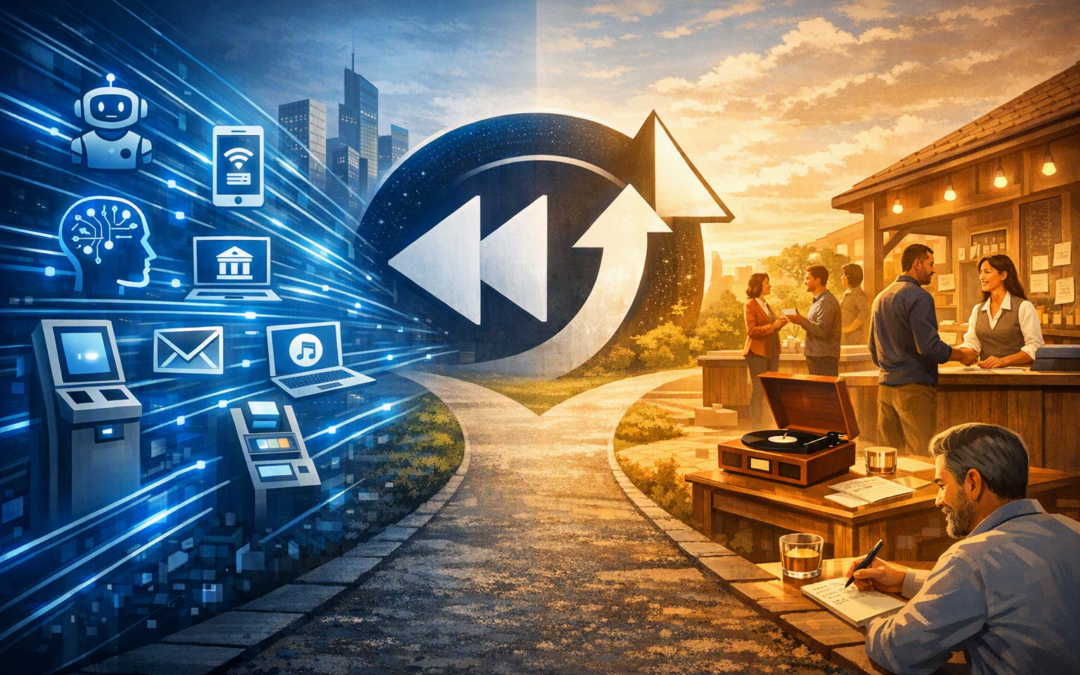
Have we confused convenience with progress? We can now bank, shop, work, message, listen, book, learn and create in seconds. On the surface, life has never been easier. But if convenience is meant to make life simpler, why do so many modern conveniences leave us feeling more frustrated, more dependent and less connected?
This is not an argument against progress. Medicine, transport, technology, education, equality, communication and research have transformed lives in ways previous generations could barely have imagined. The question is not whether progress matters. Of course it does. The better question is whether every new convenience is genuinely making life better.
One of my favourite attractions at Disney’s Magic Kingdom is Walt Disney’s Carousel of Progress. It was created from Walt Disney’s original idea in the 1960s and follows an American family through different periods of the 20th century, showing how transport, household appliances, entertainment and technology gradually made life easier. The attraction is due to close in July 2026 for a major update, with new scenes expected when it reopens in 2027. That feels like the perfect moment to ask a bigger question: if we built a Carousel of Progress for today, would the final scene feel like progress, or overload?
We often say that necessity is the mother of invention, but convenience may well be its father. Much of what we invent is designed to remove effort, reduce waiting, speed things up or make life feel more manageable. That instinct has shaped homes, workplaces, transport, communication and customer service.
But convenience has a trade-off. When something saves us time, it can also take something away: confidence, skill, patience, human contact or the satisfaction of working something out for ourselves.
The Convenience Bias
As humans, we naturally look for the path of least resistance. Our brains prefer shortcuts because thinking, deciding and doing all require energy. If there is a quicker way to achieve the same result, most of us will take it.
Artificial Intelligence is a powerful current example. Recently, I asked a well-known AI platform to create a series of Frequently Asked Questions for a service we offer. Based on experience, that task would probably have taken me a couple of hours. AI produced a strong first draft in less than 30 seconds and, with a little human judgement and editing, the whole task took less than five minutes.
That is genuinely useful. It saves time, increases efficiency and frees people up to focus on other things. But it also raises an uncomfortable question: if technology keeps removing the effort, what happens to the skills, thinking and judgement that effort used to build?
The Paradox of Convenience
The paradox of convenience is that tools designed to make life easier can sometimes make us feel less capable. When everything works, we barely notice the system around us. But when something fails, the inconvenience appears instantly.
Think about the last time your internet connection dropped, a banking app froze, a chatbot sent you in circles or a self-service checkout demanded assistance for an item you had already scanned. The task was meant to be quicker, but suddenly you were stuck, waiting, repeating yourself or trying to find a human being who could help.
That is where convenience can become fragile. The easier something is when it works, the more helpless we can feel when it does not.
Progress Does Not Always Mean Better
There is a difference between resisting change and questioning whether a change has truly improved things. We are creatures of habit, so it is easy to dismiss any discomfort with new technology as nostalgia. But something more interesting seems to be happening. In some areas, people are not simply longing for the past; they are reacting to the hidden inconvenience created by the new.
| Convenience | What it promises | What it can cost |
| Chatbots | Instant answers to simple questions without waiting in a telephone queue. | Frustration when your issue does not fit the menu and you cannot reach a person. |
| Mobile phones | Everything available instantly in the palm of your hand. | Constant distraction, reduced presence and increased dependence on being connected. |
| Quickly reaching large numbers of people with one message. | Misinterpretation, overload and important information being missed in the volume. | |
| Self-service checkouts | Faster shopping and shorter queues. | Unexpected interventions, technical errors and a less personal customer experience. |
Online banking is another useful example. For many people, it is quick, efficient and available at any time. Yet when something goes wrong, the convenience can disappear very quickly. Fraud concerns, cybersecurity risks, locked accounts and automated support journeys can make people miss the reassurance of speaking to a knowledgeable human being, especially when money is involved. This is why well-known banking establishments are looking to reinvest in bricks and mortar destinations, rewinding to the traditional ways of banking with confidence and security.
Retail is seeing a similar tension. Self-service checkouts were introduced to speed up the shopping experience, but many customers know the familiar irritation of an unexpected item in the bagging area, an age verification delay or the need to wait for assistance. Some retailers have started rethinking the balance between automation, loss prevention and customer service.
Even music tells the same story. Streaming gives us almost unlimited choice, instantly. Yet the renewed interest in vinyl suggests that some people miss the more deliberate experience of choosing an album, listening from start to finish and giving the music their full attention.
Choosing What’s Worth Keeping
So perhaps the Rewind Revolution is not about rejecting progress. It is about being more selective. Before we chase the next shiny new thing, we should ask whether it improves the experience for the people who actually have to use it.
- Who is really benefiting from this convenience?
- What problem does it solve, and what new problems might it create?
- Who might be excluded, frustrated or de-skilled by the change?
- Where do people still value human contact, judgement and reassurance?
Human endeavour has always been about improving life, shaping the world and reaching for something better. But better is not always faster, easier or more automated. Sometimes better means more human, more reliable and more meaningful.
So here is my question: if you could rewind one modern convenience and bring back the old way of doing things, what would it be, and why?